


 /
/ /
/ /
/ 008801700860845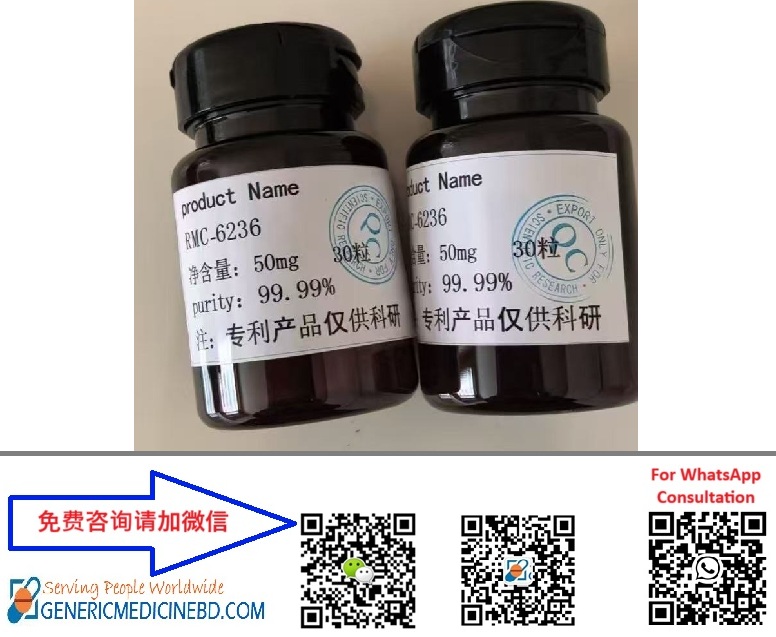
药品名称/化学名称 : Daraxonrasib, RMC-6236, RASONQUE
品牌名称/本地名称 : 国际名称:使用 : Daraxonrasib is indicated for the treatment of adult patients with metastatic pancreatic adenocarcinoma who meet either of the following criteria: 1. Have received at least one prior systemic therapy; or 2. Are not candidates for multiagent systemic therapy.
剂型 : Tablet/ Capsule
剂量 : 50mg/100mg/150mg
生产厂家 : Revolution Medicines, Inc.
包装 : 30 capsules in a bottle
Description :
DARAXONRASIB (RMC-6236)
US FDA Approved — August 26, 2026
This is a professional medical translation and independently organized reference. It is not an official manufacturer-issued package insert or a substitute for the FDA-approved prescribing information.
Product information
|
Item |
Description |
|
Generic name |
Daraxonrasib |
|
Development code |
RMC-6236 |
|
US brand name |
RASONQUE™ |
|
Pharmacological class |
RAS GTPase family inhibitor / RAS(ON) inhibitor |
|
Dosage form |
Oral film-coated tablets |
|
Available strengths |
100 mg and 150 mg |
|
Initial US approval |
2026 |
|
FDA approval date |
August 26, 2026 |
|
NDA number |
220910 |
|
Developer / Marketing authorization holder |
Revolution Medicines, Inc. |
1. Indications and Usage
Daraxonrasib is indicated for the treatment of adult patients with metastatic pancreatic adenocarcinoma who meet either of the following criteria:
- Have received at least one prior systemic therapy; or
- Are not candidates for multiagent systemic therapy.
Importantly, the FDA-approved indication does not require the detection of a specific KRAS/RAS mutation, although the vast majority of patients enrolled in the pivotal RASolute 302 study had KRAS G12 mutations.
2. Dosage and Administration
2.1 Precautions Before and During Treatment
Because dermatologic toxicity is common, the FDA prescribing information recommends initiating preventive measures from the beginning of treatment. These include:
- Applying topical corticosteroids to the face and chest.
- Using emollients and moisturizing creams.
- Limiting sun exposure and using a broad-spectrum sunscreen with an SPF of at least 30.
- Considering prophylactic oral antibiotics, such as doxycycline or minocycline, when clinically appropriate.
2.2 Recommended Dosage
RECOMMENDED DOSAGE
300 mg
Orally, once daily (QD)
Continue treatment until disease progression or unacceptable toxicity.
Administration instructions:
- Take daraxonrasib at approximately the same time every day.
- It may be taken with or without food.
- Swallow the tablets whole. Do not chew, crush or split them.
- If more than four hours have elapsed since the scheduled administration time, skip the missed dose and take the next dose at the usual time.
- If vomiting occurs after administration, do not take an additional dose. Resume treatment at the next scheduled time.
Dosage Reductions for Adverse Reactions
|
Dosage level |
Daraxonrasib dosage |
|
Standard dosage |
300 mg once daily |
|
First dosage reduction |
200 mg once daily |
|
Second dosage reduction |
150 mg once daily |
|
Unable to tolerate 150 mg once daily |
Permanently discontinue |
2.3 Dosage Modifications for Adverse Reactions
|
Adverse reaction |
Severity |
Recommended management |
|
Dermatologic toxicity / rash |
Grade 2 |
Consider withholding treatment until recovery to Grade 1 or lower. Provide supportive treatment and resume at the same or next lower dosage. |
|
Grade 3 |
Withhold until recovery to Grade 1 or lower. Provide supportive treatment and consider dermatology consultation. Resume at the next lower dosage. |
|
|
Grade 4 |
Permanently discontinue. |
|
|
Stomatitis |
Grade 2 |
Consider withholding until recovery to Grade 1 or lower. Provide supportive treatment and resume at the same or next lower dosage. |
|
Grade 3 |
Withhold until recovery to Grade 1 or lower. Resume at the next lower dosage. |
|
|
Grade 4 |
Permanently discontinue. |
|
|
Diarrhea |
Grade 2 |
Consider withholding treatment and provide antidiarrheal therapy. Resume at the same or next lower dosage after recovery. |
|
Grade 3 |
Withhold until recovery to Grade 1 or lower. Provide antidiarrheal therapy and resume at the next lower dosage. |
|
|
Grade 4 |
Permanently discontinue. |
|
|
Gastrointestinal perforation |
Grade 3 |
Withhold until recovery to Grade 1 or lower. If clinically appropriate, resume at the next lower dosage. |
|
Grade 4 |
Permanently discontinue. |
|
|
Interstitial lung disease (ILD) / pneumonitis |
Grade 2 |
Withhold until recovery to Grade 1 or lower. If appropriate, resume at the next lower dosage. |
|
Recurrent Grade 2 or Grade 3–4 |
Permanently discontinue. |
|
|
Nausea / vomiting |
Grade 3 |
Withhold until recovery to Grade 1 or lower. Optimize antiemetic treatment and resume at the next lower dosage. |
|
Grade 4 |
Permanently discontinue. |
|
|
Other adverse reactions |
Grade 3 |
Withhold until recovery to Grade 1 or lower or baseline. Resume at the next lower dosage. |
|
Grade 4 |
Permanently discontinue. |
Severity is graded according to the National Cancer Institute Common Terminology Criteria for Adverse Events (NCI CTCAE), version 5.0.
3. Dosage Modifications for Drug Interactions
Daraxonrasib is primarily a substrate of CYP3A and P-glycoprotein (P-gp). It is also a P-gp inhibitor, making the management of potential drug interactions particularly important.
|
Type of concomitant medication |
Recommendation |
|
Strong CYP3A inhibitor with P-gp inhibitory activity |
Avoid concomitant use. |
|
Strong CYP3A inhibitor without P-gp inhibitory activity |
Reduce from 300 mg to 150 mg once daily. |
|
Moderate CYP3A inhibitor with P-gp inhibitory activity |
Reduce from 300 mg to 100 mg once daily. |
|
Moderate CYP3A inhibitor without P-gp inhibitory activity |
Reduce from 300 mg to 200 mg once daily. |
|
P-gp inhibitor |
Reduce from 300 mg to 150 mg once daily. |
|
Cyclosporine A and its derivatives |
Avoid concomitant use. |
|
Strong CYP3A inducer |
Avoid concomitant use whenever possible. If unavoidable, increase to 400 mg once daily. |
|
Moderate CYP3A inducer |
Increase to 400 mg once daily. |
|
P-gp substrate |
Administer at least four hours apart from daraxonrasib. |
After discontinuing a strong CYP3A inhibitor, resume the original daraxonrasib dosage after at least five days or three to five half-lives of the inhibitor, whichever is longer.
After discontinuing a moderate CYP3A inhibitor, the original dosage may generally be resumed after three to five half-lives of the inhibitor.
Following discontinuation of a moderate or strong CYP3A inducer, the original daraxonrasib dosage may generally be resumed after 7–14 days.
4. Dosage Forms and Strengths
100
mg
100 mg film-coated tablets
Blue, oval, biconvex tablets, debossed with “R” on one side and “100 M” on the other.
150
mg
150 mg film-coated tablets
Blue, oval, biconvex tablets, debossed with “R” on one side and “150 M” on the other.
5. Contraindications
No known formal contraindications are listed.
6. Warnings and Precautions
6.1 Dermatologic and Soft-Tissue Toxicity
Daraxonrasib may cause rash, pruritus, paronychia, dry skin, skin fissures and other dermatologic reactions.
In clinical studies involving patients with pancreatic adenocarcinoma:
Overall incidence
86%
Grade 3 toxicity
10%
Median time to onset
13 days
Dermatologic toxicity resulted in treatment interruption in 24% of patients, dosage reduction in 16%, and permanent discontinuation in 0.5%.
Preventive dermatologic measures should be initiated before treatment and continued throughout therapy. Patients should be monitored for new or worsening skin reactions.
6.2 Stomatitis and Oral Toxicity
Stomatitis includes oral ulcers and oral mucositis.
The overall incidence was 57%, with Grade 3 events occurring in 9% of patients. The median time to first onset was 22 days.
Corticosteroid-containing mouthwash may be considered. Depending on clinical circumstances, supportive treatments may include chlorhexidine mouthwash, 2% viscous lidocaine and other appropriate therapies.
6.3 Diarrhea
Diarrhea occurred in 63% of patients, with Grade 3 events in 6%. The median time to first onset was three days.
Appropriate antidiarrheal treatment should be initiated promptly. Depending on severity, daraxonrasib may need to be withheld, reduced or permanently discontinued.
6.4 Gastrointestinal Perforation
Gastrointestinal perforation occurred in 0.9% of patients during clinical studies, including:
- Grade 3 events in 0.5%.
- One Grade 4 event.
- One fatal event.
If gastrointestinal perforation is suspected, daraxonrasib should be withheld immediately and the patient should undergo prompt medical evaluation.
6.5 Interstitial Lung Disease (ILD) / Pneumonitis
ILD or pneumonitis occurred in 2.4% of patients, including Grade 3 events in 0.9% and one reported fatal event.
Patients who develop new or worsening cough, shortness of breath or other pulmonary symptoms during treatment should undergo immediate evaluation, and daraxonrasib should be withheld.
6.6 Embryo-Fetal Toxicity
Animal studies suggest that daraxonrasib can cause fetal harm.
Women of reproductive potential should use effective contraception during treatment and for at least one week following the final dose.
Men with female partners of reproductive potential should also use effective contraception during treatment and for one week after the final dose.
7. Adverse Reactions
In RASolute 302, the safety population receiving daraxonrasib 300 mg once daily comprised 241 patients.
Serious adverse reactions occurred in 30% of patients. Those occurring in at least 2% included diarrhea (3.7%), fever (3.3%), sepsis (2.9%), fatigue (2.1%) and hemorrhage (2.1%).
Adverse reactions resulted in temporary treatment interruption in 69% of patients, dosage reduction in 37%, and permanent discontinuation in 2.9%.
Common Adverse Reactions
|
Adverse reaction |
All grades |
Grades 3–4 |
|
Rash |
87% |
13% |
|
Diarrhea |
67% |
7% |
|
Stomatitis |
56% |
12% |
|
Nausea |
52% |
3% |
|
Fatigue |
47% |
5% |
|
Vomiting |
42% |
1% |
|
Abdominal pain |
27% |
2% |
|
Edema |
25% |
0.8% |
|
Decreased appetite |
24% |
2% |
|
Hemorrhage |
22% |
3% |
|
Musculoskeletal pain |
19% |
0.8% |
|
Fever |
19% |
1% |
|
Paronychia |
17% |
0% |
|
Constipation |
16% |
0.4% |
|
Dry skin |
14% |
0% |
|
Pruritus |
11% |
0.4% |
|
Peripheral neuropathy |
10% |
0% |
Renal-limited thrombotic microangiopathy was additionally reported in 0.4% of patients.
Common Laboratory Abnormalities
|
Laboratory abnormality |
All grades |
Grades 3–4 |
|
Decreased albumin |
71% |
3% |
|
Decreased corrected calcium |
64% |
2% |
|
Decreased hemoglobin |
52% |
10% |
|
Increased AST |
51% |
3% |
|
Decreased lymphocyte count |
49% |
11% |
|
Decreased platelet count |
45% |
3% |
|
Increased ALT |
36% |
4% |
|
Decreased sodium |
36% |
6% |
|
Decreased white blood cell count |
35% |
3% |
|
Decreased magnesium |
34% |
1% |
|
Increased alkaline phosphatase |
29% |
2% |
|
Increased creatinine |
24% |
0.8% |
|
Decreased potassium |
20% |
3% |
8. Use in Specific Populations
Pregnancy
Based on animal studies, daraxonrasib may cause fetal harm. Human data on the use of daraxonrasib during pregnancy are currently unavailable.
Pregnancy status should be verified in women of reproductive potential before starting treatment.
Lactation
It is unknown whether daraxonrasib or its metabolites are excreted into human breast milk.
Breastfeeding should be avoided during treatment and for one week following the final dose.
Pediatric Use
The safety and effectiveness of daraxonrasib in pediatric patients have not been established.
Geriatric Use
Among the 248 patients assigned to daraxonrasib in RASolute 302, 54% were aged 65 years or older, and 18% were aged 75 years or older.
No overall differences in safety or effectiveness were observed between patients aged 65 years or older and younger patients.
Renal and Hepatic Impairment
No clinically meaningful pharmacokinetic differences were observed in patients with creatinine clearance of 30–89 mL/min or in patients with mild or moderate hepatic impairment.
However, the effects of severe renal impairment, defined as creatinine clearance below 30 mL/min, and severe hepatic impairment remain insufficiently characterized.
9. Description and Pharmaceutical Characteristics
Daraxonrasib has the following molecular formula:
C₄₄H₅₈N₈O₅S
Its molecular weight is 811.06 g/mol.
It is a white to yellow crystalline solid formulated as a spray-dried dispersion and manufactured into oral film-coated tablets.
Tablet-core excipients include butylated hydroxytoluene, colloidal silicon dioxide, croscarmellose sodium, hydroxypropyl cellulose, hydroxypropyl methylcellulose acetate succinate, magnesium stearate, mannitol and microcrystalline cellulose, among others.
10. Mechanism of Action
RAS(ON) inhibition
Targeting the Previously “Undruggable” RAS Pathway
Daraxonrasib is a RAS GTPase family inhibitor with a distinctive ternary-complex mechanism of action.
Daraxonrasib + Cyclophilin A
Binary complex formation
Binding to activated GTP-bound RAS (RAS[ON])
Ternary complex formation
Inhibition of downstream RAS signaling
Interruption of interactions between RAS and downstream effector proteins
Suppression of tumor growth and induction of apoptosis
Daraxonrasib forms a binary complex with cyclophilin A. This complex subsequently binds activated RAS proteins in their GTP-bound state, forming a ternary complex.
The resulting interaction blocks RAS binding to downstream effector proteins, promotes GTP hydrolysis and facilitates the conversion of RAS to its inactive GDP-bound state. This suppresses RAS-mediated signaling, inhibits tumor growth and induces apoptosis.
Daraxonrasib can inhibit both wild-type and mutant KRAS, NRAS and HRAS.
In RAS-dependent pancreatic adenocarcinoma models, it has demonstrated tumor-growth inhibition and tumor regression, with associated antitumor immune effects.
11. Pharmacodynamics
The complete exposure–response relationship of daraxonrasib has not yet been fully established.
Data from 466 patients with pancreatic cancer receiving doses ranging from 10 mg to 400 mg once daily indicated that higher drug exposure was associated with an increased incidence of treatment interruption, dosage reduction or discontinuation; Grade 3 or higher adverse reactions; Grade 2 or higher dermatologic reactions; stomatitis or mucositis; nausea or vomiting; and diarrhea.
At the recommended dosage, a mean QTc prolongation exceeding 20 milliseconds was not observed.
12. Pharmacokinetics
The pharmacokinetic parameters of daraxonrasib at a dosage of 300 mg once daily are summarized below.
|
Parameter |
Value |
|
Maximum plasma concentration (Cmax) |
Approximately 365 ng/mL |
|
Systemic exposure (AUC) |
Approximately 3,760 ng·h/mL |
|
Median time to maximum plasma concentration (Tmax) |
Approximately 2.2 hours |
|
Terminal elimination half-life |
Approximately 9.2 hours |
|
Apparent oral clearance |
80.4 L/hour |
|
Plasma protein binding |
Approximately 98% |
|
Primary metabolic pathway |
CYP3A |
|
Fecal excretion / recovery |
Approximately 93% |
|
Urinary excretion / recovery |
Approximately 1% |
Daraxonrasib is primarily metabolized by CYP3A.
A radiolabeled drug study demonstrated that approximately 93% of the administered radioactivity was recovered in feces and approximately 1% in urine.
A high-fat, high-calorie meal did not produce clinically significant changes in pharmacokinetics. Accordingly, daraxonrasib may be administered with or without food.
13. Nonclinical Toxicology
Carcinogenicity
Carcinogenicity studies have not been conducted with daraxonrasib.
Genotoxicity
Daraxonrasib did not demonstrate significant genotoxicity in the Ames assay, the in vitro human peripheral blood lymphocyte micronucleus assay or the mouse bone marrow micronucleus assay.
Impairment of Fertility
Dedicated fertility studies have not been conducted. No significant abnormalities of male or female reproductive organs were observed in general toxicology studies.
Animal Toxicology
In a four-week toxicity study in mice, increased bone remodeling was observed at exposures equal to or greater than the AUC exposure associated with the recommended human dosage. These effects were partially reversible.
14. Pivotal Clinical Trial: RASolute 302
Randomized, multicenter trial
ClinicalTrials.gov: NCT06625320
RASolute 302 was a global, randomized, open-label, multicenter trial involving patients with metastatic pancreatic adenocarcinoma whose disease had progressed following first-line systemic therapy and who had an ECOG performance status of 0–1.
Trial design
500 patients
Randomized 1:1
248
Daraxonrasib
300 mg orally once daily
252
Standard chemotherapy
Physician-selected regimen
Standard chemotherapy options included mFOLFIRINOX, gemcitabine plus nab-paclitaxel, FOLFOX, or liposomal irinotecan plus 5-fluorouracil/leucovorin (nal-IRI + 5-FU/LV).
Efficacy in the Overall Population
Key clinical results
Median overall survival
13.2 mo
vs 6.7 months
OS hazard ratio: 0.40
Median progression-free survival
7.2 mo
vs 3.6 months
PFS hazard ratio: 0.49
Daraxonrasib versus standard chemotherapy.
|
Efficacy endpoint |
Daraxonrasib |
Standard chemotherapy |
|
Median overall survival (OS) |
13.2 months |
6.7 months |
|
OS hazard ratio |
0.40 |
— |
|
Median progression-free survival (PFS) |
7.2 months |
3.6 months |
|
PFS hazard ratio |
0.49 |
— |
|
Objective response rate (ORR) |
30% |
11% |
|
Complete response (CR) |
1.2% |
0.8% |
|
Partial response (PR) |
29% |
10% |
The differences in OS, PFS and ORR were statistically significant, with p<0.0001 for all three endpoints.
Efficacy in Patients with RAS G12 Mutations
A total of 459 patients had RAS G12-mutated disease.
|
Efficacy endpoint |
Daraxonrasib |
Standard chemotherapy |
|
Median OS |
13.2 months |
6.6 months |
|
OS hazard ratio |
0.40 |
— |
|
Median PFS |
7.3 months |
3.5 months |
|
PFS hazard ratio |
0.45 |
— |
|
ORR |
32% |
11% |
In the overall study population, approximately 92% of patients had KRAS G12 mutations, 5% had mutations at other KRAS sites, such as G13 or Q61, and approximately 3% had no RAS mutation detected by local testing.
15. How Supplied and Storage
Packaging
|
Tablet strength |
Package |
National Drug Code (NDC) |
|
100 mg |
Bottle containing 30 tablets |
85219-101-01 |
|
150 mg |
Bottle containing 30 tablets |
85219-104-01 |
Each bottle contains a desiccant and is fitted with a child-resistant closure.
Storage Conditions
RECOMMENDED STORAGE TEMPERATURE
20–25°C
Controlled room temperature. Temporary excursions to 15–30°C are permitted.
16. Patient Counseling Information
Patients should be advised to report rash, itching, paronychia or severe dry skin promptly. They should be instructed to practice appropriate sun protection and regularly moisturize their skin.
Patients should seek immediate medical attention if they develop severe or persistent abdominal pain, vomiting blood, black stools, fever or chills, as these may indicate gastrointestinal perforation.
New or worsening cough, shortness of breath, wheezing or other respiratory symptoms require urgent medical evaluation to exclude ILD or pneumonitis.
Significant oral ulcers, oral pain or difficulty swallowing should be reported to the treating clinician. New or worsening diarrhea should also be addressed promptly.
Patients should provide their healthcare professionals with a complete list of prescription medicines, over-the-counter products, vitamins and herbal preparations so that potential drug interactions can be evaluated.
FDA Approval Status
The US Food and Drug Administration formally approved daraxonrasib on August 26, 2026, for the treatment of metastatic pancreatic adenocarcinoma in the eligible adult population described above.
The recommended FDA-approved